TD Bank
Reimagined a complex internal account opening flow for one of North America’s largest banks.
Role → UX Designer
Duration → 1 year
Tools → Adobe XD, a lot of Teams meetings
01
Overview
TD Bank was one of the most detailed client engagements I’ve worked on. While it wasn’t the most creatively thrilling, it was an extremely solid example of what it’s like to function as an embedded, in-house product designer at an enterprise level for a financial institution.
The TD team brought us on as an external partner, but for over a year, I functioned as an internal designer across several flows. I was one of multiple designers on the project, each assigned to a different section of the internal banking system. Our job was to update and modernize their outdated internal tools and flows- primarily focusing on rebuilding and annotating key process flows used by internal bankers.
02
Context
03
Scope of Work
Redesigned Key Process Flows: The largest initiative I handled was redesigning the full internal flow that bankers use to open new client accounts. This involved dozens of screens and hundreds of variations to cover every state.
Component Behavior & UI Streamlining: I worked within their existing visual style guide but created new interface patterns where needed, ensuring consistency in interaction design across all components (modals, alerts, notifications, etc.).
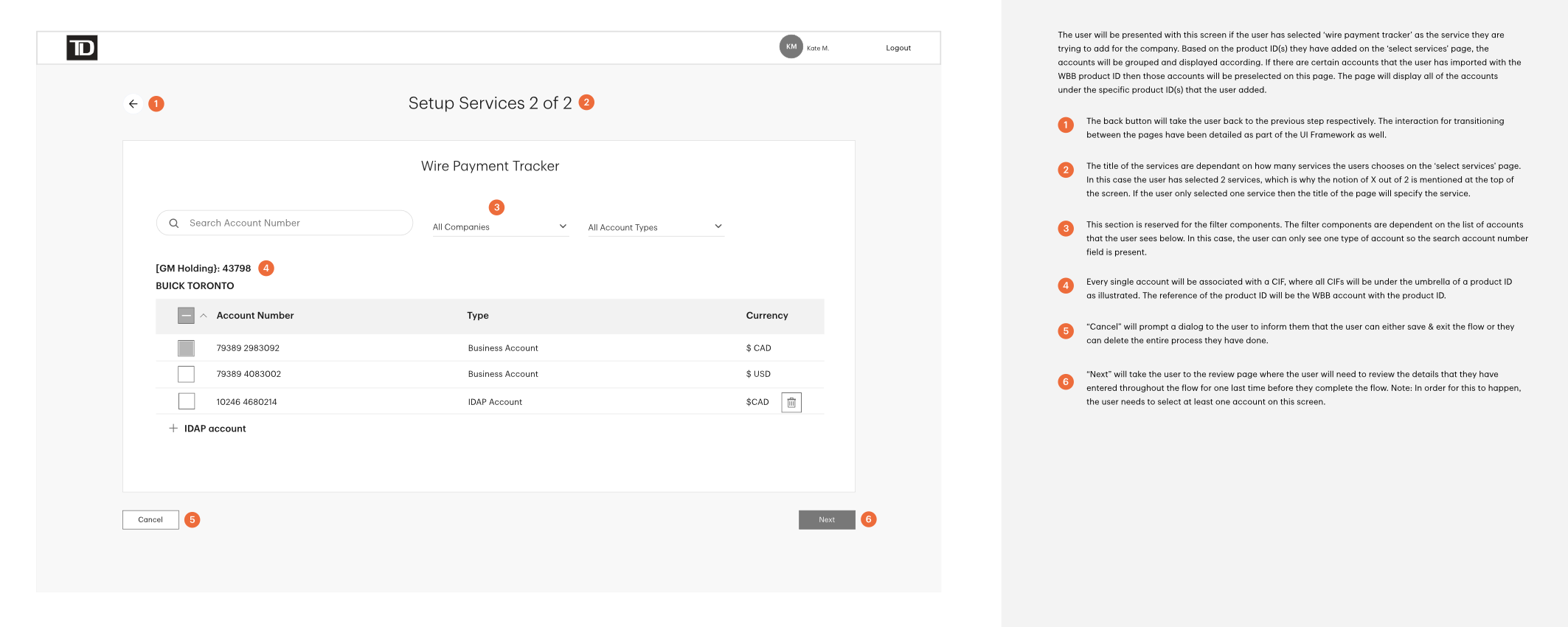
Annotation-Heavy Delivery: TD required incredibly granular documentation. I produced hundreds of annotated screens that described not just the visual components, but the functionality, conditional behaviors, and rationale.
Cross-functional Collaboration: I worked directly with both business stakeholders and developers. I would meet with the business team to understand needs, translate those into UX solutions, and then regularly collaborate with engineering to ensure accurate builds and catch implementation errors.
04
Design Process
This project leaned more toward execution than ideation. The business teams already had a clear understanding of what they wanted- our job was to bring it to life with clarity and precision. There was minimal user research or open-ended discovery work, but deep attention to detail was critical. I ensured every edge case, state, and transition was accounted for.
This project required deeply layered annotations in lockstep with the dev team- think states on states on states. We made sure every click, error, and edge case was accounted for, documented, and relayed in the language we all understood.
05
Team Structure
I was part of a large team of designers that came in to work on different initiatives in tandem. My role was to listen to business requirements, build out designs that met those goals, present and refine them with stakeholders, and work closely with developers to ensure smooth implementation. While we had a lead overseeing overall project coordination, the core design execution, annotations, and delivery were my responsibility.
Reflection
TD was thrilled with the output. Their internal teams finally had clean, modern flows to work with, and the development handoffs were smooth due to the level of specificity we delivered. The end result was a significantly improved internal experience for bankers, with reduced friction, clearer workflows, and better visual hierarchy.
Though not glamorous, this project exemplifies my ability to work in a corporate product environment, navigate large teams, manage detailed annotation workflows, and build clean, intuitive designs at scale. It's a great example of the kind of reliable, low-ego, high-output work I can bring to a team that values clarity and execution.